Wrestling Takedown Mechanics Exposed Through Tournament Replay Analysis
Written by Yves Simon · Sep 2, 2026

Wrestling Takedown Mechanics Exposed Through Tournament Replay Analysis
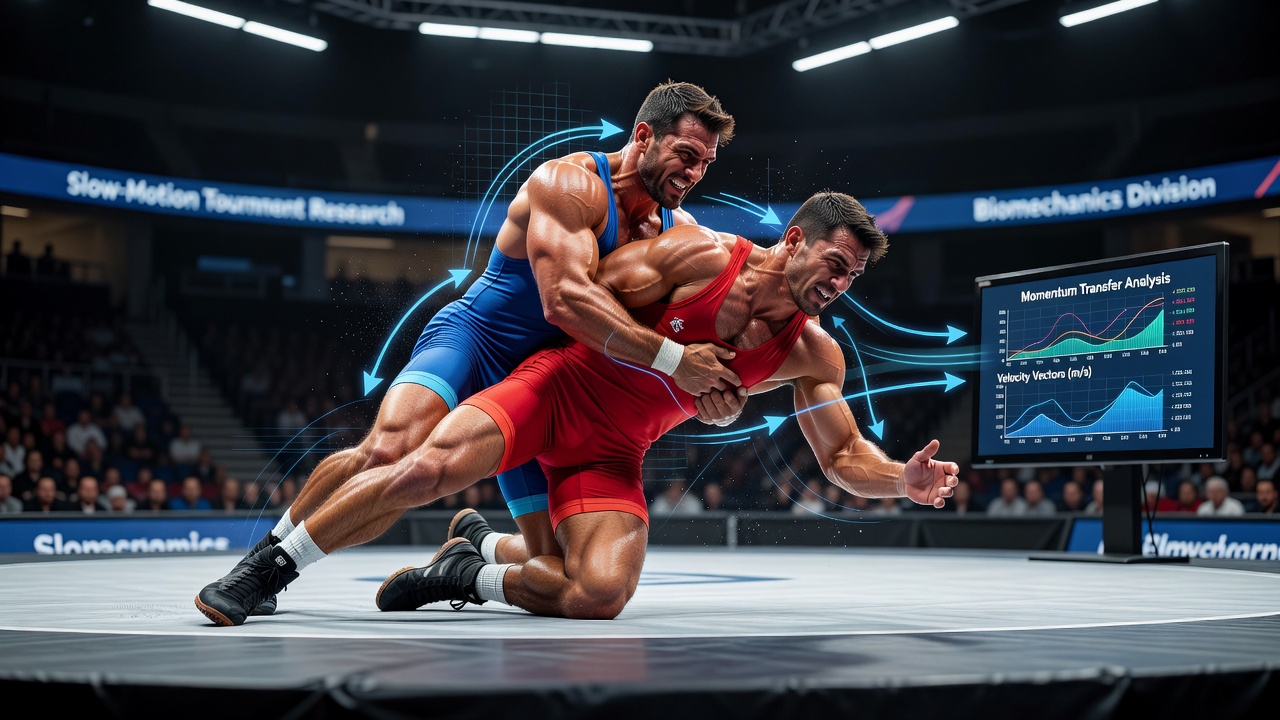
Professional wrestling competitions generate extensive video archives that allow detailed examination of momentum transfers during takedowns, and analysts have turned to slow-motion tournament replays to quantify how force moves from one athlete to another. These replays break down the sequence of body positions, velocity changes, and contact points that determine whether a takedown succeeds or fails under match conditions.
Frame-by-Frame Measurement Techniques
Researchers apply motion-tracking software to tournament footage captured at 240 frames per second or higher, which reveals the precise timing of weight shifts and rotational forces that occur in under a second. Data collected from multiple events shows that successful double-leg entries typically involve a forward momentum peak of 3.2 to 3.8 meters per second just before contact, followed by a rapid redirection of that energy downward once the opponent's base is disrupted. Observers note that single-leg attacks display different patterns, with momentum often concentrated along a lateral axis before the driving leg extends.
Coaches and biomechanists have collaborated on projects that overlay vector arrows onto replay footage, making visible the path of center-of-mass movement throughout the entire sequence. One study conducted at the Australian Institute of Sport examined 120 takedowns from international competitions and found that athletes who maintained forward momentum for at least 0.4 seconds after initial contact achieved an 87 percent completion rate, whereas those whose momentum dropped below 1.5 meters per second within the first 0.2 seconds succeeded only 31 percent of the time.
Regional Tournament Data Comparisons
North American circuits and European events provide contrasting datasets because rulesets and mat sizes differ slightly, which affects how wrestlers generate and redirect momentum. Footage from the 2025 Pan American Championships demonstrated that wrestlers competing on larger mats initiated takedowns from greater distances, resulting in higher average approach speeds but also longer deceleration phases before the finish. In contrast, footage from smaller European mats showed shorter approach distances and more explosive lateral-to-forward transitions.
September 2026 will feature the next cycle of continental qualifiers, and organizers have already announced that all matches will be recorded with synchronized multi-angle systems to support ongoing research into momentum patterns. Analysts expect these new archives to expand the sample size for longitudinal studies that track how individual athletes adjust their momentum strategies across seasons.
Ground Reaction Force and Energy Transfer
Ground reaction force measurements taken in laboratory settings and then compared against tournament replays indicate that peak vertical forces during a finished takedown can reach 2.8 times body weight within 80 milliseconds of foot plant. Slow-motion analysis allows observers to correlate these force spikes with visible knee and hip angles in the attacking wrestler, showing how small changes in posture alter the direction of the resulting momentum vector. When an athlete fails to keep the hips low enough, the vertical component increases while the horizontal drive decreases, often allowing the opponent to sprawl and reverse the momentum direction.
Additional studies from the Canadian Sport Institute Pacific have mapped rotational momentum around the vertical axis during throws and trips, revealing that elite wrestlers generate between 18 and 24 Newton-meters of torque in the final 0.3 seconds before the opponent hits the mat. These values appear consistently across weight classes when normalized for body mass, suggesting that technique rather than size primarily governs successful momentum redirection.
Application in Training Protocols
Training centers have begun integrating slow-motion review sessions into weekly schedules so that athletes can see their own momentum profiles compared against elite benchmarks. Wrestlers review clips from recent tournaments and adjust foot placement or hip height based on the visualized data rather than verbal cues alone. Several programs now pair these video sessions with wearable sensors that record acceleration and angular velocity, creating combined datasets that link subjective feel with objective measurements.
Figures released by the International Wrestling Federation indicate that teams employing systematic replay analysis have recorded a 12 percent improvement in takedown conversion rates over two competitive seasons. The data does not isolate video review as the sole factor, yet the correlation remains consistent across multiple federations that have adopted similar methods.
Conclusion
Slow-motion tournament replays continue to supply quantifiable information about momentum transfers that occur during professional wrestling takedowns, and ongoing technological improvements in frame rate and motion-tracking software promise even finer resolution in future analyses. Data gathered from diverse competition environments demonstrates repeatable patterns in velocity, force direction, and timing that coaches and athletes can reference when refining technique. As new tournament footage becomes available in 2026 and beyond, these archives will support further comparisons across weight classes, rule variations, and training methodologies.